
Updated November 2026: we reviewed this article against current official sources.
- Budget 2026 kept tax rates unchanged; the Income-tax Act, 2025 applies from April 1, 2026, so section numbers (such as 80C) have changed even though the deductions continue under the old regime.
- 80C-type deductions (PPF, ELSS, tax-saver FD) and the extra ₹50,000 NPS deduction are available only under the old regime. Under the default new regime, only the employer’s NPS contribution (up to 14% of salary) is deductible.
- PPF interest is 7.1% for October–December 2026 (unchanged).
- Equity LTCG (including ELSS) is taxed at 12.5% on gains above ₹1.25 lakh a year since July 23, 2024 (previously 10% above ₹1 lakh).
As the financial year gets underway, the familiar question begins to echo in the minds of savvy investors: “What’s the best way to save tax under Section 80C?” Too often, this decision is a last-minute scramble, resulting in choices based on convenience rather than financial goals. But what if you chose the right instrument for your portfolio—one that not only saves tax but also builds significant wealth?
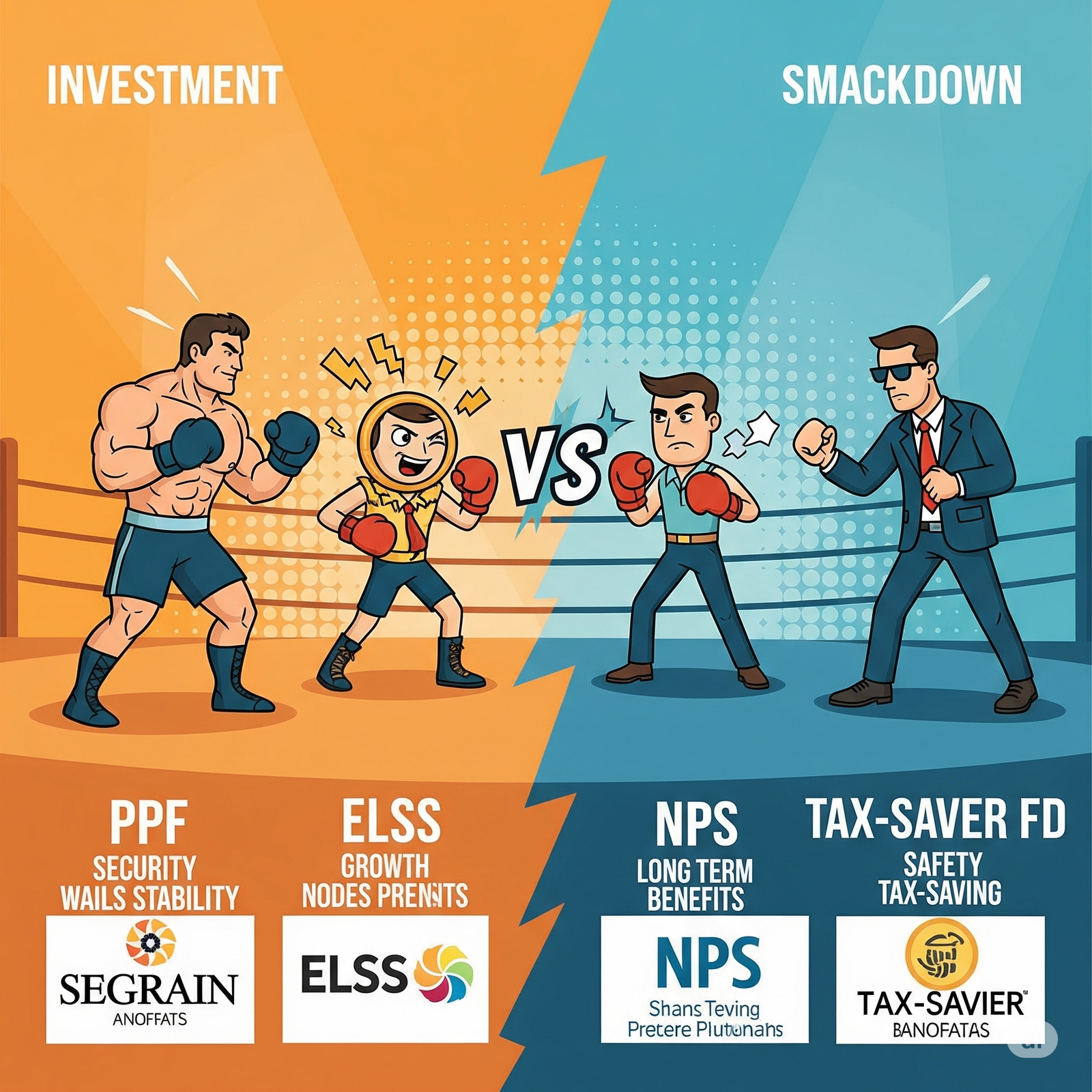
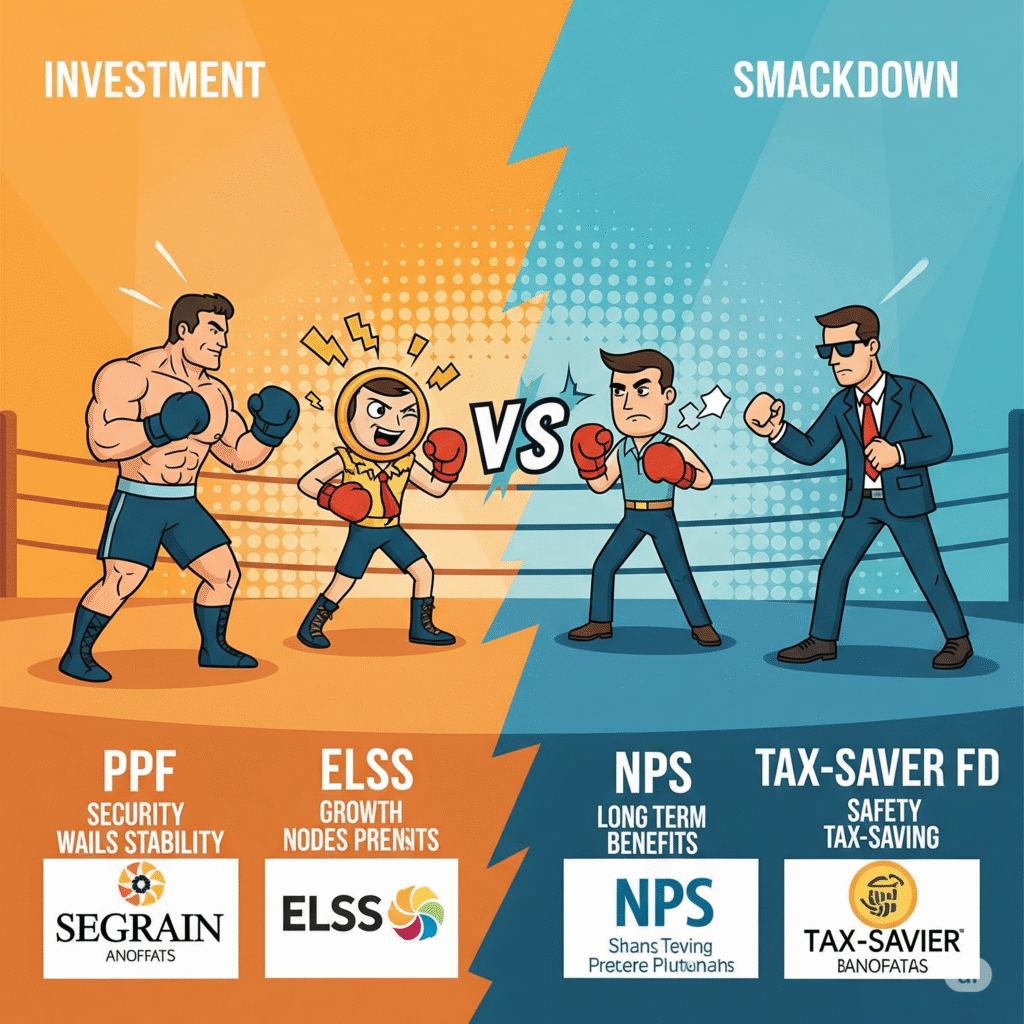
Welcome, Taxtotech Readers, to the ultimate tax-saving smackdown for the financial year 2025-26! In the ring today are four heavyweights of the investment world, each vying for that ₹1.5 lakh spot in your portfolio:
- The steady and reliable Public Provident Fund (PPF)
- The agile, high-growth Equity Linked Savings Scheme (ELSS)
- The long-term champion, the National Pension System (NPS)
- The simple and secure Tax-Saver Fixed Deposit (FD)
This isn’t just a comparison; it’s a head-to-head analysis to help you declare a winner for your financial future. At Taxtotech, we believe smart tax planning is the foundation of strategic wealth creation. Let the smackdown begin!
Meet the Contenders: A Quick Introduction
Before they touch gloves, let’s get to know our four fighters.
- Public Provident Fund (PPF): A government-backed, long-term savings scheme. It’s the picture of safety, offering guaranteed, tax-free returns. Think of it as the defensive master of the group.
- Equity Linked Savings Scheme (ELSS): A type of mutual fund that invests primarily in the stock market. ELSS is the aggressive attacker, offering the potential for high returns but coming with market risk. It also boasts the shortest lock-in period.
- National Pension System (NPS): A government-sponsored pension scheme designed purely for retirement planning. It’s the endurance athlete, mixing equity and debt for long-term growth with a very long lock-in period until age 60.
- Tax-Saver Fixed Deposit (FD): A straightforward fixed deposit offered by banks with a 5-year lock-in. It’s the reliable beginner, easy to understand and offering fixed, predictable returns.
PPF vs ELSS vs NPS vs Tax-Saver FD
The Main Event: The Ultimate Comparison Table
Nothing tells the full story like a side-by-side comparison. This detailed table breaks down our contenders across every crucial parameter.

| Parameter | Public Provident Fund (PPF) | Equity Linked Savings Scheme (ELSS) | National Pension System (NPS) | Tax-Saver Fixed Deposit (FD) |
|---|---|---|---|---|
| Risk Level | Risk-Free (Sovereign Guarantee) | High (Market-Linked) | Medium to High (Market-Linked) | Low (Bank Risk) |
| Returns | Govt-set quarterly (Currently 7.1%) | Market-driven (Avg. 12-15% historically) | Market-driven (Avg. 8-12% historically) | Fixed by bank (Varies, 6-7.5%) |
| Lock-in Period | 15 years | 3 years (Shortest) | Until age 60 (Longest) | 5 years |
| Tax on Maturity | Exempt (EEE Status) | Taxable (LTCG tax of 10% on gains over ₹1 lakh) | Partially Taxable (60% lump sum is tax-free) | Taxable (Interest is taxed at your slab rate) |
| 80C Deduction | Up to ₹1.5 lakh | Up to ₹1.5 lakh | Up to ₹1.5 lakh (Tier 1) | Up to ₹1.5 lakh |
| Extra Tax Benefit | No | No | Yes (Extra ₹50,000 u/s 80CCD(1B)) | No |
| Liquidity | Low (Partial withdrawal after 7 years) | High (After 3 years) | Very Low (Partial withdrawal for specific reasons) | None (Premature withdrawal not allowed) |
Round-by-Round Analysis: Declaring a Winner for Each Goal
Let’s see how our contenders fare when judged on specific financial goals.
Round 1: Highest Return Potential – The Winner is ELSS! There’s no contest here. By investing in the equity market, ELSS has the potential to deliver inflation-beating returns that can create significant wealth over the long term. While past performance is no guarantee, historical averages for ELSS funds have comfortably hovered in the 12-15% range, far outpacing the other instruments.
Round 2: Lowest Risk & Capital Safety – PPF Takes the Crown! For investors who prioritize the safety of their capital above all else, PPF is the undisputed champion. Backed by a sovereign guarantee from the Government of India, your investment and the interest earned are completely secure. It’s the ideal choice for building a risk-free corpus for long-term goals.
Round 3: Shortest Lock-in Period – ELSS Wins by a Knockout! With a mandatory lock-in period of just three years, ELSS offers the highest liquidity among all Section 80C instruments. This makes it an attractive option for investors who want to save tax but don’t want their money tied up for 5, 15, or even 30 years.
Round 4: Maximum Tax Saving – NPS with a Surprise Uppercut! While all four contenders offer a deduction of up to ₹1.5 lakh under Section 80C, NPS has a secret weapon. It offers an additional, exclusive deduction of ₹50,000 under Section 80CCD(1B). This means a taxpayer can claim a total deduction of up to ₹2 lakh by investing in NPS, making it the technical winner for pure tax-saving power.
The Final Verdict: Your Perfect Tax-Saving Match
So, who is the ultimate champion? The truth is, there’s no single winner. The best instrument depends entirely on you—your age, your financial goals, and your comfort with risk.
| Your Profile | Primary Goal | Recommended Instrument(s) | Why It’s a Good Fit |
|---|---|---|---|
| The Young Aggressive Investor (Age 20-30) | High Growth & Wealth Creation | ELSS | Long time horizon allows you to ride out market volatility for high potential returns. |
| The Balanced Mid-Career Pro (Age 30-45) | Growth with Safety | ELSS + PPF / NPS | A diversified approach. ELSS for growth, and PPF/NPS to build a stable, risk-free retirement corpus. |
| The Conservative Pre-Retiree (Age 45-55) | Capital Protection | PPF + Tax-Saver FD | Focus shifts to protecting your accumulated wealth. These offer guaranteed returns and low risk. |
| The First-Time Investor | Simplicity & Safety | Tax-Saver FD or PPF | Easy to understand and invest in, providing a safe entry into the world of tax-saving investments. |
Smart Financial Planning with Taxtotech
Choosing the right tax-saving instrument is the first step. The next, more crucial step is integrating this choice into your broader financial plan and ensuring you claim the benefits accurately when you file your ITR. A wrong calculation or a missed claim can negate all your smart planning.
At Taxtotech, our platform and expert services are designed to help you move beyond simple tax-saving to strategic wealth management. We provide the tools and insights to help you see the bigger picture, ensuring your investments and tax filings work in perfect harmony. Ready to build a smarter financial future? Connect with our experts at https://taxtotech.com today.
Conclusion: The Champion is Your Choice
The results of our tax-saving smackdown are clear: there is no one-size-fits-all winner. The champion of Section 80C is the instrument that best aligns with your personal financial journey.
For Taxtotech Readers, the ultimate strategy is often diversification. By combining the high-growth potential of ELSS with the safety of PPF and the unique tax benefits of NPS, you can build a robust, tax-efficient portfolio that works for you today and for years to come.
Call to Action:
Which instrument is your go-to for tax saving? Did our smackdown change your mind about your investment strategy for 2025-26? Share your thoughts and questions in the comments below!
Disclaimer: This article is for general informational purposes only and does not constitute legal, financial, tax, investment or immigration advice. Rates, thresholds, benefit amounts and deadlines change and depend on your circumstances. Verify details with the official source (such as the IRS, HMRC, DWP, CRA, the Income Tax Department of India or the UAE Federal Tax Authority) and consult a qualified professional before acting. taxtotech.com is not affiliated with any government agency.
Frequently Asked Questions (FAQs)
Q1: Can I invest more than ₹1.5 lakh in these instruments? A: Yes, you can invest as much as you want in most of these (PPF has an annual cap of ₹1.5 lakh). However, the tax deduction under Section 80C is capped at a total of ₹1.5 lakh across all eligible investments.
Q2: What does EEE, as in PPF, stand for? A: EEE stands for Exempt-Exempt-Exempt. It means the investment amount is deductible (Exempt 1), the interest/returns earned are tax-free (Exempt 2), and the maturity amount is also tax-free (Exempt 3). It’s the most favorable tax status.
Q3: Are the returns from ELSS and NPS guaranteed? A: No. Both ELSS and NPS are market-linked instruments. Their returns depend on the performance of the underlying assets (stocks and bonds) and are not guaranteed.
Q4: Can I break a Tax-Saver FD before the 5-year lock-in period? A: No, premature withdrawal from a tax-saver fixed deposit is generally not allowed, except in specific circumstances like the death of the primary account holder.
Q5: Can I open a PPF account for my child? A: Yes, you can open a PPF account in the name of your minor child. However, the total investment across your own account and your minor child’s account cannot exceed the ₹1.5 lakh annual limit.
Related posts:
 Maximising Your UK State Pension: How to Fill NI Gaps and Boost Your Weekly Income
 State vs Workplace Pensions: Understanding Contributions, Tax Relief & Optimal Retirement Strategy
 Anthropic IPO: Date, Price Range, Ticker (ANT) and How to Buy Shares (2026)
 2026 Year-End Tax Checklist: 9 Moves to Make Before December 31