How much UK State Pension will you actually get? The answer depends on your National Insurance (NI) record and when you reach State Pension age. This guide, updated in November 2026 with the official 2026/27 rates, explains the full and reduced amounts, how they’re calculated, and how to increase what you’ll receive. All figures are from GOV.UK and DWP.
The 2026/27 rates
| Pension | Who gets it | Full rate per week (from 6 April 2026) | Full rate per year (approx.) |
|---|---|---|---|
| New State Pension | Men born on or after 6 April 1951; women born on or after 6 April 1953 | £241.30 | about £12,548 |
| Basic State Pension | People who reached State Pension age before 6 April 2016 | £184.90 | about £9,615 |
Both rose by 4.8% in April 2026 under the “triple lock”, which increases the State Pension by the highest of earnings growth, CPI inflation or 2.5%. Earnings growth was the highest measure this time. Sources: GOV.UK new State Pension, House of Commons Library.
Full vs reduced: how the new State Pension is worked out
- Fewer than 10 qualifying years: usually no new State Pension.
- 10 to 34 years (if your NI record started after April 2016): you get a proportion, roughly 1/35 of the full rate for each year.
- 35 years: the full rate, if your record started after April 2016.
If you had an NI record before 2016, DWP calculated a “starting amount” in April 2016 based on the old rules. If you were contracted out of the Additional State Pension (common for public-sector and many final-salary scheme members), your starting amount may be lower and you may need more than 35 years to reach the full rate. If your starting amount was higher than the full rate, the extra is paid as a “protected payment”.
Example amounts (record starting after April 2016)
| Qualifying years | Weekly amount 2026/27 (approx.) |
|---|---|
| 9 or fewer | £0 |
| 10 | £68.94 |
| 20 | £137.89 |
| 30 | £206.83 |
| 35 | £241.30 |
These are simple 1/35 calculations for illustration. Your forecast is the reliable figure.
What counts as a qualifying year?
A tax year counts if you:
- worked and paid Class 1 NI (in 2026/27, earnings over £242 a week from one job), or earned between £129 and £242 a week, where contributions are treated as paid;
- were self-employed and paid, or were treated as paying, Class 2 NI;
- received NI credits, for example while claiming Child Benefit for a child under 12, Carer’s Allowance, Universal Credit or certain sickness benefits;
- paid voluntary contributions.
Source: Your State Pension explained (GOV.UK).

How to check your amount
- Go to Check your State Pension forecast.
- Sign in and review how much you could get, when, and whether you can increase it.
- Look at your NI record for gaps, especially years marked “not full”.
Ways to increase your State Pension
| Option | How it works | Points to note |
|---|---|---|
| Voluntary Class 3 contributions | £18.40 a week in 2026/27, about £957 for a full year | Check first that it will raise your pension. Usually you can fill gaps from the last 6 years. |
| Claim NI credits | Make sure you get credits you’re entitled to, such as Specified Adult Childcare credits for grandparents caring for a grandchild under 12 | Some must be claimed; they aren’t automatic. |
| Defer your pension | Your new State Pension increases by 1% for every 9 weeks you defer (about 5.8% a year) | The extra is taxable and may affect means-tested benefits. |
| Keep working | More qualifying years if you’re below 35 or contracted out | NI stops once you reach State Pension age. |
Our guide to filling NI gaps explains this in more detail.
If you reached State Pension age before April 2016
You are on the old system: the basic State Pension (full rate £184.90 a week in 2026/27) plus any Additional State Pension (SERPS or State Second Pension) you built up through earnings. You needed 30 qualifying years for the full basic amount. Some people can also get a top-up based on a spouse’s or civil partner’s record. Your annual statement from the Pension Service shows the breakdown.
Spouses and inheritance
The new State Pension is mostly based on your own record. In some cases you may inherit part of your late spouse’s or civil partner’s Additional State Pension or protected payment, depending on when you married and when each of you reached State Pension age. See GOV.UK: inheriting State Pension.
Is the State Pension taxable?
Yes. It is paid without tax deducted, but it counts towards your income. The full new State Pension in 2026/27 (about £12,548) is just below the £12,570 personal allowance, so pensioners with other income, such as a workplace pension, will usually pay income tax through PAYE on that income.
Pension Credit if your income is low
If your income is low, Pension Credit can top it up and may unlock help with housing costs, council tax and the Winter Fuel Payment. Check eligibility with the Pension Credit calculator.
Pros and cons of paying voluntary NI
- Pros: one year of Class 3 costs about £957 and, for many people, adds roughly £6.89 a week (about £358 a year) for life.
- Cons: it won’t help if you’ll already reach the maximum or if you were heavily contracted out; always check your forecast first.
Disclaimer: This article is for general informational purposes only and does not constitute legal, financial, tax, investment or immigration advice. Rates, thresholds, benefit amounts and deadlines change and depend on your circumstances. Verify details with the official source (such as the IRS, HMRC, DWP, CRA, the Income Tax Department of India or the UAE Federal Tax Authority) and consult a qualified professional before acting. taxtotech.com is not affiliated with any government agency.
FAQ
How much is the full State Pension in 2026?
£241.30 a week for the new State Pension and £184.90 a week for the basic State Pension, from 6 April 2026.
How many years do I need for a full pension?
Usually 35, but possibly more if you were contracted out before 2016.
Can I get a State Pension with 9 years?
Usually not; 10 qualifying years is the minimum.
When will I reach State Pension age?
It’s 66 now and rising to 67 for people born on or after 6 April 1960, phased in between 2026 and 2028.
Is the State Pension paid weekly?
It’s usually paid every four weeks into your bank account.
Can I get a State Pension forecast by post?
Yes, by contacting the Future Pension Centre.
Related posts:
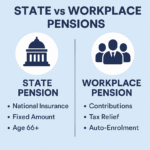 State vs Workplace Pensions: Understanding Contributions, Tax Relief & Optimal Retirement Strategy
 What Will Be Your State Pension Age? A Complete Guide to UK Pension Age & Recent Reforms
 Why Women Earn Less in Pensions: Unpacking the Gender Pension Gap in the UK
 How to Claim Your UK State Pension from Abroad (2026/27 Guide for Expats)